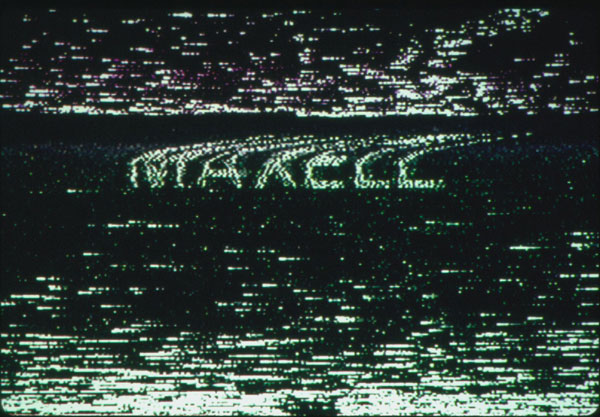
Follow link to be taken to Video Data Bank's page on Now.
Tuesday, March 29, 2011
Krauss
The Aesthetics of Narcissism
"The Aesthetics of Narcissism"
Krauss emphasizes the concept of narcissism being portrayed in modern day video art. An analogy is made between video art and a mirror because they provide instant feedback from the artist to the viewers. I also like the metaphor of painting that was used in that in a psychological state is create to "paint" on the film. Towards the end of the reading, Krauss talks about Campus' video Vertical Roll. She makes a reference to this triangular relationship that is created between the camera, the projection device and the wall. The other figure is himself and he comes in and out of the frame. I feel that many video artists use self-portraits in their video art and Campus' video is an ideal example. He spotlights himself in various different ways.
Tough reading assignment, as I'm sure you are aware :)
The Aesthetics of Narcissism: Krauss Reading
He discusses that it is difficult for some to accept this idea of video being narcissism perhaps because video requires certain physical mechanisms. However, the illusion that video can depict to the viewer represents and presents a different notion of an "extraordinary image of distraction". Krauss explains that artists achieve this with video through the simultaneous reception and projection of an image and the human psyche used as a conduit. He continues this discussion by explaining that use of these two features in video causes the present to appear to collapse onto itself because it is replaced simultaneously by itself and is instantly made into past history. This causes one to question present, past, and time in general. Whether the artist uses mirrors to view or audio, Krauss describes that the play with history is created with the use of text to tie one moment to the previous one.
Krauss exclaims that many compare this reflective mode or process to the way an artist would use a reflexive process with a different medium discourse. However, he describes reflective to be different than reflective instead of reflective simply being a variation of reflexive because reflective mode deals with radical symmetry and reflexive deals with radical symmetry. He describes the reflective mode, unlike the reflexive, implies the "vanquishing of separating" of subject and object. This fusion of subject and object actually diffuses the object, which Krauss describes as the electronic equipment and its capabilities, and enforces the notion of video being narcissism and not about its physical aspects.
Krauss: The Aesthetics of Narcissism
The aesthetics of narcissism
The Aesthetics of Narcissism Response
I found this reading somewhat difficult to really get in to however, I thought that Krauss had some really interesting points. He says that video has the ability to be a simultaneous reception and projection of an image; this medium in which the past and present stand side by side is set apart from other physical art forms which exist in or represent one place and time. Some of the video projects mentioned that I found particulary engaging were Boomerange, Air Time and Now.
In Boomerang, the mirroring of Holts voice and her spoken thoughts that overlap and confuse each other as they are also confusing the participant and audience creates a situation in which the past and present are almost intertwining but in a way that appears forced. In a way this makes me think of the scramble of thoughts in my own head when I become really stressed or have a lot to think about: nothing is organized and as thoughts build confusion erupts and you lose sight of what you were trying to concentrate upon. The symbol of a boomerang to represent her ideas returning back to her is really effective for this piece as well. Air Time and Now function in a similar manner as Boomerang, but in a more visibly understood manner. ByAcconci talking to the image of himself he is able to reflect upon his own self, much like Holt is reflecting upon the playback of what she had previously said and Benglis’ video of her body working side by side with her body in the past also references this merging of the past and present into one time frame in which they become able to coexist.. The use of the word now within the video is a more direct relation to Boomerang in that the audio is relapsing upon itself, almost creating a musical rhythm of sorts. I especially liked how they referred to this overlapping of audio in saying that all layers of the now are equally present and the individual has no past and no connection to objects that are external to it.
Krauss’ emphasis on narcissism within these and the other video works mentioned makes sense in that as video artists are learning to explore the medium as well as their relation to it they focus upon their relationship with the medium. I think that is present in almost any art form though. Most artists (working in all mediums) work with their bodies by creating self-portraits that are conceptually or literally a reflection of themselves. The only difference with other art forms is that the image takes on a different aesthetic when transformed into a medium such as painting, drawing or sculpture while video art is more representational of the actual human form and voice and thus more narcissistic. As art is largely an expression of ones self I have always understood such video art as reflective and exploratory more so than narcissistic.
Monday, March 28, 2011
The Aesthetics of Narcissism

Vito Acconci's Centers
Wednesday, March 23, 2011
Tuesday, March 22, 2011
Five Obstructions Blog Post
Five Obstructions Response
The Five Obstructions Response
The Five Obstructions response
The Five Obstructions
This film is an amazing, living psychoanalysis of the self-destructive human character. It follows one man's ambitious pursuit of perfection while battling the most difficult obstacle he could ever face: his own impossible expectations. At the beginning of the film it appears as if the man has been worn weary by his severity, and in order to battle a fit of depression a friend chose to impose a litany of obstructions on a previously seminal work of his. Though this appears counter-intuitive, the placed obstructions actually served as a distraction to the man's own obstructive behavior. By forcing the man to go places he had never willingly gone before out of the intention of not satisfying himself, but another man's criteria, the man was able to learn how to preserve his sense of identity throughout his work instead of sacrificing it for the sake of the work. At the final moment of letting go of his self-destructive behavior, the man learns that he was living up to not only the once-in-a-lifetime success of his most seminal film, but the message of it: to become the perfect human.
"This is how the perfect man falls."
Five Obstructions Film
The Five Obstructions
Monday, March 21, 2011
the five obstructions
5 Obstructions Response
The Five Obstructions
Obstructions Screening
Saturday, March 19, 2011
The 5 Obstructions
Thursday, March 17, 2011
Memoryscape Blog
Memoryscape
memoryscape reading
Memoryscape Reading
Memoryscape Reading
Memoryscape
Tuesday, March 15, 2011
Memoryscape
Memoryscape Reading
In the past, certain sounds meant certain things were to happen (such as the ball) and for the most part, this is still true today. Aldous Huxley said that in this century we have covered "physical noise, mental noise and noise of desire". I agree with this statement and that the sounds we hear today are in either one of those categories. Sometimes we know what a sound is exactly and other times we can predict what we want from the sounds we hear. I would love to do as Russolo says and walk with my ears instead of my eyes. I feel that I don't appreciate natural sounds or pay attention to the sounds around me. Janet Cardiff's "Louisanna Walk#14" sounds really interesting and i really like the concept of walking through a garden. It seems very relaxing.
Memoryscape
Monday, March 7, 2011
Sound Effects Link
Here is a link on the sound archive website that has some great short sound effects.
Thursday, March 3, 2011
MemoryScape response
I thought that this article had some really engaging points. The way in which he talks about the connection made between geographical context and people is something that I can relate to personally and that I find interesting. Sounds define so much of our experience within a space, even when we may not notice their existence or impact upon our understanding of an environment.
While I think that the development of such updated tracking systems is actually quite awful and scary, the way in which he applies their function to our experience of our context brings about a whole new way of looking at such technology. Yi-Fu Tuan and Edward Relphs argument that the bond between people and places have a fundamentally important part of our experience informs this development in technology in the sense that such a bond grows from a greater understanding and comfort with ones surroundings. In this sense, this technology can almost override the difficulties of that definition which are the conceptions of mobile or traveling individuals because one can become more accustomed to and more connected to a place simply by understanding the dynamics of that context better through the use of such devices (as well as personal experience). Additionally, the part of the reading that discussed the rapidly changing character of modern, urban life related a lot to what we talked about in class and references the advances of technology in a different respect. As we discussed in class, noises of nature have always been around us but the introduction of such complex noises that were harsh and startling when they were first heard interrupt the environment in which they are placed and thus do change the relationship between the environment and the people who live there. Personally I don’t really see this as a negative change; I agree with Thompson that these noises have much to offer in terms of soundscapes and creating environments as well as Russolos appreciation of such industrial noises that are used to create performances that sensitize people to the music of every day sound. The use of such noises to compose an orchestra or harmony of sound is intriguing and really effective when done as a site specific project because it creates a musical character of the place and its inhabitants.
Memoryscape article Response
sound blog post
Tuesday, March 1, 2011
Nicola Costantino
Daros Latinamerica Collection, Zürich.
Photo by Peter Schälchli, Zürich.
Artist Nicola Costantino has a solo exhibition on display in collaboration with Daros Latinamerica as guest of Migros Museum of Contemporary Art. The exhibition features sculptural objects, installations, and photographs by the artist from the 1990s to present day.
Here's a link to the E-flux write about the show!
Mundane Ethnobotany
New exhibition by artist Jef Geys entitled Woodward Avenue now on display at the Museum of Contemporary Art Detroit.
From the exhibition article:
Operating across conventional boundaries that often limit discourse within the social, the political, and the aesthetic, Jef Geys' Woodward Avenue is guided by an intellectual curiosity that incorporates collaboration and community, with a distinct conceptual method grounded by the unambiguous reality of plant life. Linking two seemingly different places in Bolivia and Detroit, the films included in the exhibition were made by Vandebroek during her workshops and edited with detached precision by Geys. Revealing sensitivity to the utility of indigenous plants among traditional healers, which occasionally contrasts with the biomedical healthcare providers conventional practice, the films broaden the scope of the exhibition geographically, while underlining the persistent gaps in the promise of modernity routinely filled by the perennial resourcefulness of those on its margins.
There's No Sound In My Head - Mark Applebaum
There's No Sound In My Head from lateral on Vimeo.
Luigi Russolo reading
Art of Noise Response
The Art of Noise: Response
The Art of Noise Response
Later in the article Russolo talks about how there is no point to to noise that is only pleasant to the ear, and it is not productive to reject exclusively loud noises. Looking at it from an artist point of view, I can kind of see how images that are pleasing to the eye have just as much power as those that aren't. The same goes here with sound/music/noise. Just because a noise is not thought of as conventional, it is not useful to only write it off as annoying or loud. These noises have just as much meaning (maybe more?) than those that are simply agreeable to the ear. This relates to my conclusion from before, of no sound being sound itself. No sound/noise has just as much meaning as one that is traditional music or more futurist compositions.